- Work
- Game
TARA
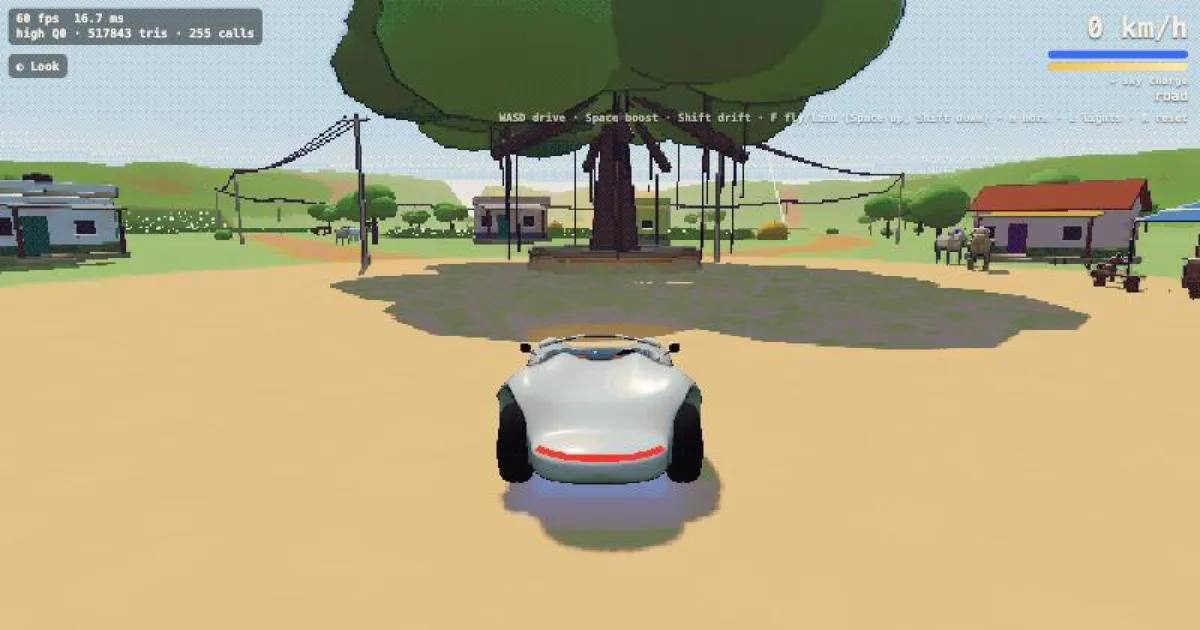
A story-driven 3D driving game set in a village in Vidarbha. Every model, texture and sound is made in code.
- Type
- Game
- Year
- 2026
- My role
- Direction, story, engineering
- Status
- Playable preview
- Built with
- Three.js
- TypeScript
- Rapier physics
- WebGL shaders
- Vite
- Links
- Play the preview
TARA is a story-driven 3D driving game that runs in a browser tab. A glowing electric roadster falls from the sky into a cotton field in Kesarpur, a fictional village in Vidarbha, Maharashtra. Gauri, who is 19, and the car’s AI, TARA, set out to recover TARA’s lost memory across ten chapters.
It is in development. The driving, the village, flight and the story systems are playable today, and the chapters are being written.
Why this game
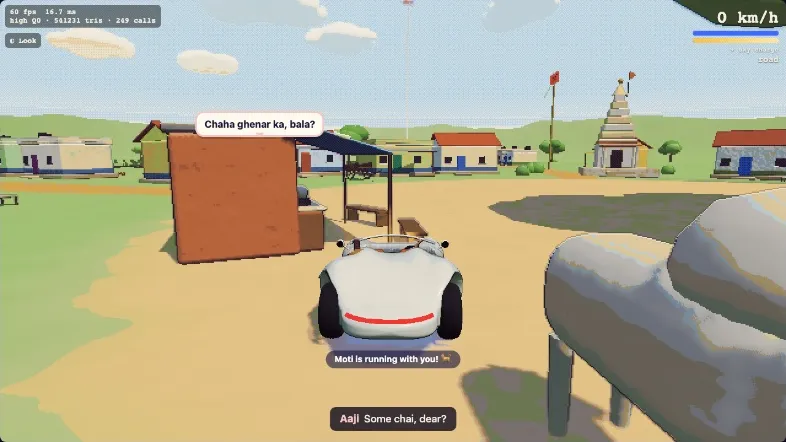
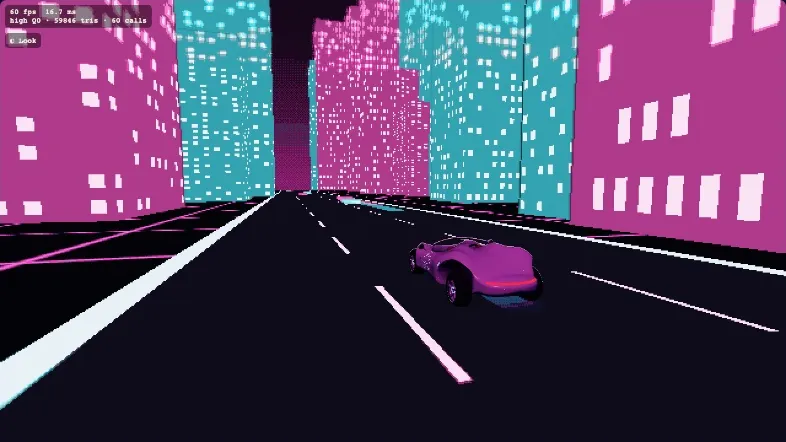
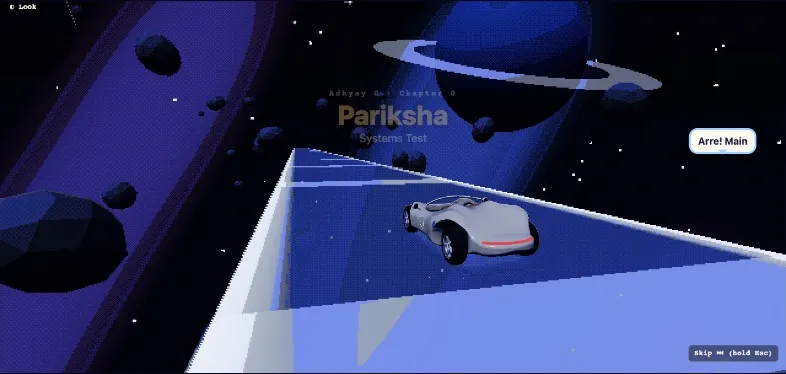
I’m from Nagpur, in Vidarbha. I wanted a game that looks and sounds like home: a banyan tree, a tea stall, a temple, a dog called Moti who runs alongside the car. The dialogue is Hinglish with Marathi words, and English subtitles are always available. Each recovered memory flashes to another world, such as a neon city, deep space or a wasteland, so the village stays the heart of the story.
Rules I set before writing any code
- Every asset is made in code. Geometry, textures, materials and most sounds. No downloaded models, images or music.
- The car is the hero. TARA gets the most detail and the best shader. Nothing else in the game may look better than her.
- It has to run well. The target is 60 fps on a mid-range laptop and 30 fps or more on a mid-range Android phone, checked at every phase.
- The car is original. No real brand, badge or shape.
How it’s built
- Rendering. Three.js on WebGL2. The signature look is “clay and pixel”: the world is drawn at low resolution with ink outlines, a palette lookup and ordered dithering, while TARA stays crisp on her own layer. A second, realistic style uses the same geometry.
- The car. A procedurally lofted body with a pearl clay material: clearcoat, iridescence, star-dust flecks and a mud mask. A light-bar brow shows eight emotions, and the headlights pulse when she talks.
- Driving. A Rapier raycast vehicle with arcade assists: grip assist, drift, a boost tank, air control and self-righting. Keyboard, gamepad, touch and tilt all work.
- Flight. TARA can fly in short, purposeful bursts limited by “Sky Charge”, which refills fastest while drifting.
- Story systems. Chapter title cards, cutscenes on a dolly rail with letterboxing, dialogue bubbles pinned to characters, and objective cards with distance.
- Quality. A device-aware quality tier plus an adaptive ladder at runtime. Logic is covered by unit tests, and a browser test checks that the game boots and the first chapter loads with a clean console.
Working with AI on a project this size
TARA is built with an AI coding assistant, one phase at a time. The whole game started as a written brief: the story, the hard rules, the tech stack and the phases. Each phase ends the same way. Run it, take screenshots, summarise in five lines, and wait for my “go”. A handoff file records every decision that overrides the brief, so a fresh session can pick up exactly where the last one stopped. I wrote about that approach in how to write a CLAUDE.md.
Hiring, or building something?
I'm open to software engineering roles and interesting collaborations. I work remotely from Nagpur and I'm used to teams spread across time zones.