- Work
- Game
Keycraft Arcade
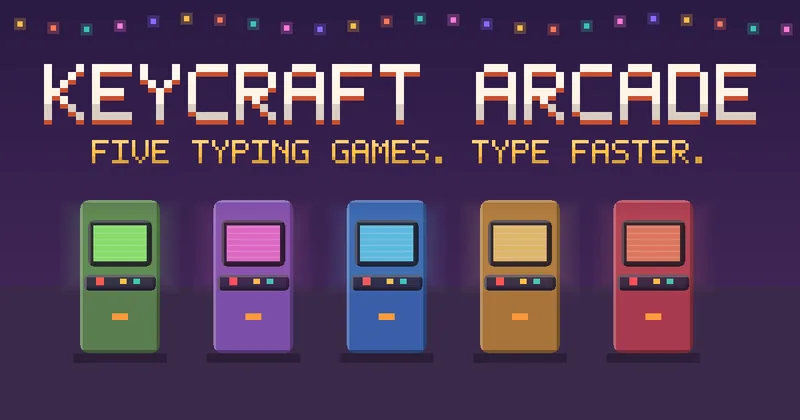
Five typing games in a cozy pixel-clay arcade. Get faster without noticing you're practicing.
- Type
- Game
- Year
- 2026
- My role
- Design, engineering
- Status
- Live
- Built with
- React
- Three.js
- PixiJS
- TypeScript
- Tone.js
- Links
- Play Keycraft Arcade
Keycraft Arcade is a typing trainer disguised as an arcade. You walk up to a glowing cabinet, pick a game and play. Every word you type shoots a zombie, lands a punch, fires a laser or moves a story forward, and the arcade quietly trains the keys you miss most.
It’s free, runs in the browser, needs no sign-up and saves progress on your device.
Five cabinets, one profile
- Zombie Siege. Type the word over a zombie’s head before it reaches your barricade.
- Rhythm Typer. Words fall down four lanes. Land the last letter on the beat. Five original tracks from 80 to 160 BPM.
- Arcade Blaster. Every correct key fires a laser at descending ships, with a boss armoured in a whole sentence.
- Typed Adventure. Branching fantasy and horror stories you move forward by typing, each with three endings.
- 1v1 Typing Battle. Two clay fighters, best of three. Longer words hit harder.
All five games share one typing profile, so every round counts toward the same progress.
The training underneath
- A one-minute benchmark sets every game to your level, and difficulty keeps adjusting as you play.
- Weak-key training. The arcade notices which keys trip you up and feeds you more of them.
- A finger map after each round shows where your misses landed and which finger slipped most, with a one-click drill for it.
- The Typing Academy has five lessons from home-row basics to symbols, with a finger guide.
- Echo, the last opponent in the battle game, adapts to your speed: “I type exactly like you. Just a little better.”
How it’s built
- React for the arcade shell and menus, with Three.js for the 3D arcade room and PixiJS for the 2D games.
- Tone.js and Howler for music and sound, which matters most in Rhythm Typer, where a hit is judged against the beat.
- Progress, scores and the typing profile are stored in the browser’s own database, so nothing leaves the device.
What I learned
Practice sticks when it doesn’t feel like practice. The same weak-key data that would make a dull drill makes a good boss fight. It ships through the same pipeline as every game in Play Arcade. If you want the typing advice without the games, I wrote a practical plan to type faster.
Hiring, or building something?
I'm open to software engineering roles and interesting collaborations. I work remotely from Nagpur and I'm used to teams spread across time zones.