- Work
- Platform
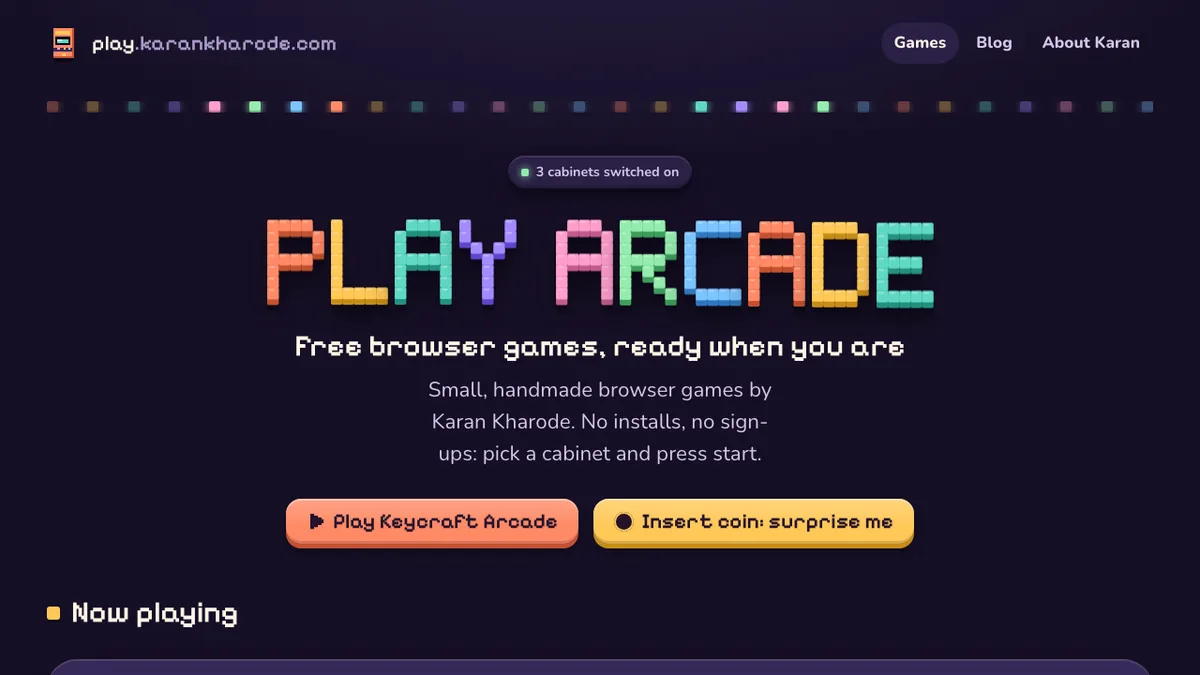
Play Arcade
A game portal and the pipeline behind it: every new game gets a repo, a subdomain, a page and a listing automatically.
- Type
- Platform
- Year
- 2026
- My role
- Architecture, engineering, DevOps
- Status
- Live
- Built with
- React
- Vite
- TypeScript
- Vercel
- Cloudflare DNS
- GitHub API
- Links
- Open Play Arcade
Play Arcade is the home for my browser games, and the machinery that puts them there. The visible part is a portal at play.karankharode.com. The part I’m prouder of is the pipeline: I say “ship this game”, and about two minutes later it has a private repo, a live subdomain, a page with its own search listing, and a spot in the catalog.
The portal
- Data-driven. The portal has one small list of game repos. At build time it reads each game’s
game.json, README and cover image straight from GitHub and generates the catalog. A game’s README is its landing page. - Prerendered. React renders every page to static HTML at build time, so titles, descriptions and content work without JavaScript, and the pages load fast.
- Images done once. Covers are resized into several WebP sizes plus a light social-card image, with real width and height so nothing shifts while loading.
- Search-ready. Each game page has structured data that describes it as a free browser game, a canonical URL, social cards, a sitemap with real last-modified dates, and an
llms.txtsummary for AI tools. - A player built in. Play opens the game inside the portal, with full screen, sharing and a “Jump back in” row that remembers what you played, all stored in your own browser.
- Self-refreshing. A webhook rebuilds the portal whenever a game repo changes, and a daily job catches anything the webhook missed.
The pipeline
Shipping a game used to be ten small chores: create a repo, connect hosting, add DNS, wait for HTTPS, make a cover, write a description, list it. None of it is hard, and missing one step means a broken or invisible site. So I wrote the recipe once, as a skill an AI assistant can run:
- Propose a short name, a description and tags. I approve.
- Screenshot the running game for the cover.
- Do a dry run that changes nothing, so problems show up first.
- Create a private GitHub repo and push.
- Create a Vercel project that redeploys on every push.
- Give the game its own subdomain and wait for HTTPS.
- Add it to the portal’s list.
- Open both pages in a browser and check them.
A wildcard DNS record means I never touch DNS for a new game.
What I learned
Plain-words instructions beat clever prompts. The recipe reads like notes for a new teammate, including what never to do. Because every step is small and lives in Git, a bad deploy is one click to roll back, which is why I’m comfortable letting AI run it. I wrote the full story in Shipping solo with AI.
Hiring, or building something?
I'm open to software engineering roles and interesting collaborations. I work remotely from Nagpur and I'm used to teams spread across time zones.